October 2026
Bird Sightings
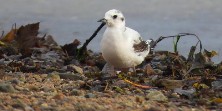

October was damp, mild at times with periods of strong winds including two consecutive named storms. October is arguably the busiest birding month, as summer breeders depart, migrants pass through, and winter visitors arrive. As in recent previous months, coastal areas including Kilbrannan Sound were alive with seabirds, hundreds of birds including gulls, auks, Shags and Gannets all feeding The presence of a variety of cetaceans including a hump-backed whale helped make it another memorable month of wildlife watching.
Migration was in full flow in October as birds were moving out of colder northern Europe to milder climes. These included: three Golden Plover, two hundred Skylark, sixty Linnet, three Twite and fifty-one Dunlin all on the same southern shore in early October, seventy Siskin in Newton on 8th, sixteen Curlew round Lamlash Bay on 15th, a female Merlin on the Boguille on 18th, thirty Turnstone in Cordon on 19th, six Snow Bunting on Goatfell on 20th, one Whimbrel in Catacol Bay on 26th, one Bar-tailed Godwit on flooded Brodick Golf Course also on 26th, thirty-six Lapwing in Torbeg on 27th and one White Wagtail on Brodick Golf Course also 27th. In addition some unusual gulls were reported: two different first winter Mediterranean Gull one, on the Fisherman’s Walk on 16th, and one at Glenashdalewaterfoot on 27th plus a first winter Little Gull on Fisherman’s Walk also on 27th. Unusual members of the crow family tuned up as well, a rare vagrant Jay in Glenree on 16th, a storm blown Magpie in Brodick on 25th as well as regular wintering Rook including fifteen on Cleats Shore on 8th .
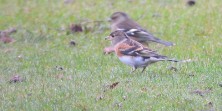
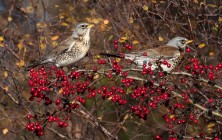
Other winter visitors arriving included: two hundred and fifty-six Pink-footed Geese flying over Cleats Shore on 8th, fourteen Teal at Carlo on 9th, two hundred and twenty Greylag Geese on Cleats Shore on 11th, a female Blackcap in a West Mayish garden on 23rd, twenty Wigeon in Torbeg on 27th and a Brambling in a flock of sixty Chaffinch on Brodick Golf Course also on 27th . In October, Redwing and Fieldfare both arrived in numbers. The first report of Redwing was on 5th in Sannox and the first report of Fieldfare was later on 18th in Lochranza. The largest group of Redwing and Fieldfare were at Cnoc na Dail entrance on 31st with four hundred and sixty Redwing and three hundred and seventy five Fieldfare.
There were some “last sightings” of summer visitors also moving south including: one House Martin in Lochranza on 1st, four Lesser Black-backed Gull also in Lochranza on 2nd, six Swallow in Whiting Bay on 12th and a female type Wheatear at Drumadoon Point on 15th . Gannet were reported throughout the month with the largest group being seventeen off Kingscross on 6th .
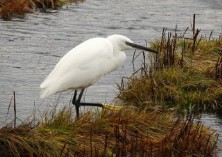
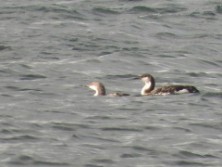
Other interesting records, from a month with over one hundred species reported, included: an adult and a juvenile Golden Eagle over the Boguille on 2nd, one hundred Starling in Sliddery on 4th, four Black-throated Diver off Drumadoon Point on 6th, eighteen Red-breasted Merganser off Pirnmill on 8th, four Little Grebe in Loch Ranza on 10th, one hundred and six Shag in Clauchlands also on 10th, a Kingfisher in Whitefarland on 11th, fifteen Long-tailed Tit in Lochranza on 15th, two White-tailed Eagle consuming a gull on the shore at Whitefarland on 16th, five Great Northern Diver off Pirnmill on 31st, eleven Grey Heron at Alltgobhlach on 28th, a Red Kite over Levencorroch also on 28th, twenty-two Greenfinch at Fisherman’s Walk also 28th and sixteen Red-legged Partridge by Cleiteadh Buidhe on 31st. Increasingly as winter approaches, Dipper can be seen at the mouth of rivers and burns and Little Egret continues to become established with forty-eight widespread records in October including five at Cordon on 27th. Not in time for the September Annual Clyde Eider Survey, there were one hundred and fifty-seven in Lamlash Bay on 28th.
Finally, my thanks to all the “volunteers” who took part in the Eider survey in late September. Coverage this year has again been excellent of not only the main island of Arran but also of Pladda and Holy Isle. As well as shores being walked, some participants did counts from various small boats and kayaks. In addition, COAST provided RV Coast Explorer to help count round Holy Isle and Lamlash Bay. The result of all these efforts was fourteen Eider, a decrease on the count for 2025 which was thirty-two. In 2022 it was fifty-five. In 2020 it was seventy-five. In 2000, it was considerably more, at over six hundred. Eider are in decline. For the latest report from Chris Waltho who has been coordinating this research for thirty plus years, visit this website: