Night Rafting on Arran
Reports
Ewan Urquhart is a regular visitor to Arran. He runs a blog called Black Audi Birding This, with Ewan’s permission is an extract from his blog.
This spring two weeks were spent on our favourite Isle of Arran in our favourite house that lies right on a rocky seashore that is but a few metres below a wall that guards the house from the sea.
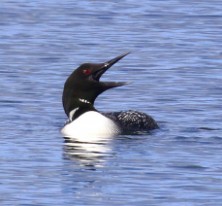
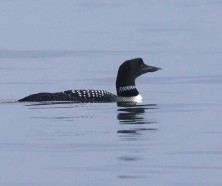
In particular, I look forward to seeing a spectacular bird that never fails to cause me to look in awe and admiration at its beauty and magnificent presence. I speak of the Great Northern Diver and to add to my sense of anticipation I know that most will be in full summer plumage. I am familiar with them in winter around the coastlines of northern Britain and even on our local inland reservoir in Oxfordshire but always in dull grey, non-breeding plumage. Not so on Arran where they are transformed to a wonder of black and white chequering with a black and white striped 'vicar's collar' around their neck and eyes the colour of rubies, glistening in a huge head and with a bill of matching black.
Being so close to the sea we can sit by the wall and watch them as they come in close to the shore hunting butterfish, flatfish and crustaceans in the shallows and where they do not even have to dive but rather snorkel with head either submerged or just above the water, in order to seize their prey. The bay that our house looks out onto is called Drumadoon and is a particularly favoured haunt of these divers and where I have never failed to see less than half a dozen every morning, each bird cruising over the sea in stately fashion and always alone
This year we were blessed with glorious weather and the sea, especially in the evening, would become almost glass like with no wind and sunsets to rival anywhere in the world. The divers can become quite vocal in these conditions and at this time of day as the world here seems to fall into quiescence and reflection, their haunting other worldly cries come from far out in the Sound, touching some primaeval nerve within me that brings a confusing onset of emotion, thrilling but also unsettling.
In the late evening, in such conditions the divers can congregate into loose groups, a behaviour that has only relatively been discovered and described as 'night rafting' and is likely to be for protection and energy conservation. Although they feed alone during the day, the divers gather in small groups that join others to eventually form larger groups that spend the night in an area well offshore. This behaviour is recognised as being crucial for over twenty percent of the Great Northern population that originate from their breeding areas in Greenland and Iceland and spend the winter around Britain's northwestern coasts
I was fortunate to observe this behaviour on the evening of the 30th of April 2026.
As the light faded between eight and nine o' clock and the sun set over Kintyre I watched a group of eight Great Northerns swim past in the middle of the Kilbrannan Sound, heading out to the more open deeper sea. A short while later another group of eleven were slowly swimming in the same direction to join other small parties of fellow divers. They do not feed but swim slowly with obvious purpose to a destination known only to them. These congregations are quite distinctive on the smooth water and I watched them until they merged into the fading distance and I could see them no more. In total I counted thirty seven Great Northern Divers.
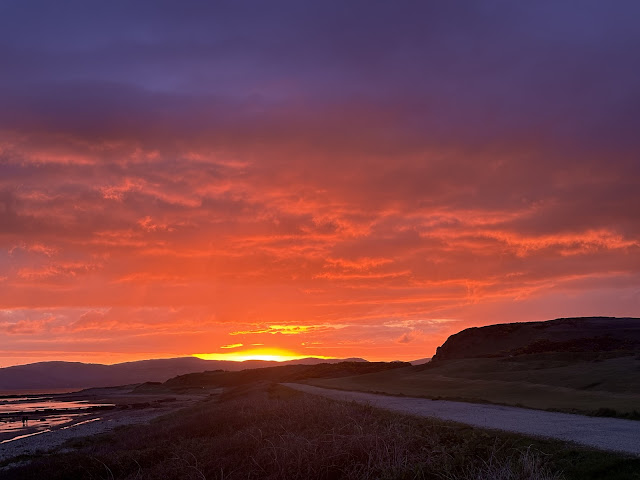
Turning away to the west I watched the last of the departing sun's yellow orb sink behind Kintyre, the sky flame orange that was almost imperceptibly turning to a gentle rose pink above the island's topography, now become indistinct and magical in a technicolour dusk. The composer Benjamin Britten and poet W. H. Auden combined to put one of Auden's poems to music and within which is contained a memorable but melancholy line from the poem which goes Love's all over the mountains where the beautiful go to die And so it felt on Arran at that moment.