Cetti's Warbler First for Arran
Reports
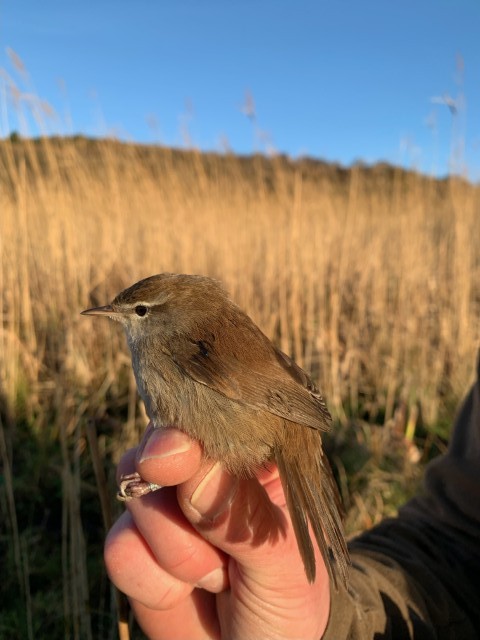
On Tuesday 30 December 2025 a first year female Cetti’s Warbler was caught, ringed and photographed by licensed ringers in the south of Arran. This is the first ever Arran record of this species whose range, like that of Little Egret, is spreading north. As the welfare of the bird is always the main concern, at this stage the exact location is not being released. The appropriate form along with photographs of this rarity has been submitted to the Scottish Birds Records Committee (SBRC) for ratification.
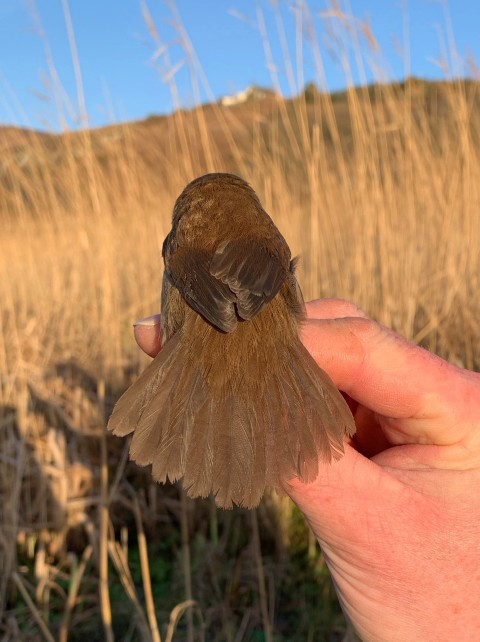
The ringers were familiar with the species through work in England, Israel, and Spain. This is an extract from their account of that morning. “Mist nets had been routinely put up to see what birds were around. A small dark brown bird disappeared into the undergrowth, and as it did so it seemed to fan its tail. I thought to myself that didn’t half look like a Cetti’s Warbler. I also recognised the call. Approximately forty minutes later we heard the bird call again and soon after this it turned up in one of the nets.” A fantastic end to birding on Arran in 2025.
Cetti's warbler, Cettia cetti, is a small, brown warbler in the family Cettiidae, which breeds in southern and central Europe, northwest Africa and the east Palearctic as far as Afghanistan and northwest Pakistan. The sexes are alike. The bird is named after the 18th century Italian zoologist, Francesco Cetti. Small and rather undistinctive, Cetti's Warbler (pronounced chetty) is a shy bird that likes to skulk about in patches of scrub, reeds and long grass. Its loud bursts of song mean you'll usually hear it before you see it. But if you're determined to spot one, look for a dark, rather stocky warbler with short wings and a full, rounded tail, diving for cover.
The Cetti's Warbler has undergone range expansion in recent decades. It first bred in Britain in the early-1970s, in Kent. Its range has since moved northwards and it now breeds through to northern England and Wales, although in fairly discrete areas. The winter range is similar. It is likely that the Cetti's Warbler's colonisation of Britain has been facilitated by climatic warming. As the species' range has expanded, its UK population has also risen. In Scotland there have only been around twenty records. There was one in the 1990s, one in 2014, one in 2016 and sixteen already ratified in the 2020s. Most records in Scotland so far have been in Dumfries and Galloway but the second Scottish record was in Barra.
Uniquely among British-breeding passerines, Cetti's Warblers have only 10 tail feathers, instead of the usual 12.