Arran’s Changing Greylag Goose Population
Reports
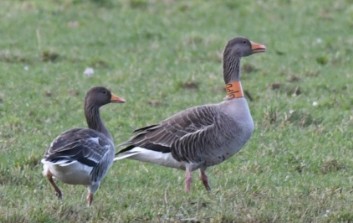
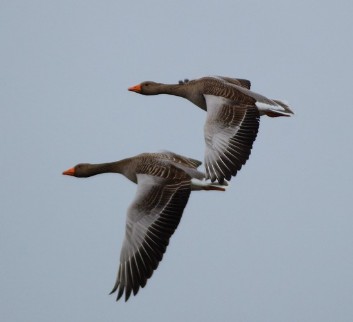
Over a hundred Greylag Geese in the Shiskine Valley in August. From the annual Arran Bird Reports stretching back over forty years, migratory Greylag Geese arrive in the valley mid to late October and leave again at the end of March to mid-April. What is happening?
The Greylag Goose is probably the most familiar of all the geese seen in Britain. It is the only native wild goose breeding in Britain. In addition it is the species from which most farmyard geese were bred. The big deep-based bill, pink or orange, is an eye catching feature plus the pink legs. The Greylag Goose is also bigger, bulkier and paler than other grey geese. In particular the head, neck, chest, belly, upper-wing, under-wing and rump can all look conspicuously pale grey, making flight identification relatively easy.
According the Wildfowl and Wetlands Trust two populations of Greylag Goose occur in Britain. A migratory population breeds in Iceland and winters predominantly in northern and western Scotland, with smaller numbers in eastern Scotland, northern England, Ireland, southwest Norway and the Faroe Islands. A largely sedentary naturalised population also exists, which occurs in much of Britain particularly on the Hebrides, the north and west Scottish mainland, Orkney, Shetland and throughout large parts of south and east England. The naturalised population has expanded its range greatly in recent years, and now overlaps with migratory birds during the winter.
According the Wildfowl and Wetlands Trust two populations of Greylag Goose occur in Britain. A migratory population breeds in Iceland and winters predominantly in northern and western Scotland, with smaller numbers in eastern Scotland, northern England, Ireland, southwest Norway and the Faroe Islands. A largely sedentary naturalised population also exists, which occurs in much of Britain particularly on the Hebrides, the north and west Scottish mainland, Orkney, Shetland and throughout large parts of south and east England. The naturalised population has expanded its range greatly in recent years, and now overlaps with migratory birds during the winter.
Both populations are present on Arran.
The migratory population come from Iceland and as indicated in the opening paragraph are regular in terms of arrival and departure. The numbers of these geese vary but the maximum reported each year is around four hundred and fifty. There is no obvious trend in population. This is a small number in comparison with for example the 35,000 Barnacle Geese which winter in Islay. The areas favoured by the migratory Greylag Geese on Arran are the farm lands in the Shiskine valley and around Clachaig in the south of the island.
The naturalised population on Arran, which is here all year round, tends to favour the land around Lamlash and Brodick in areas like Clauchlands, Glenkiln and Mayish. They have been reported breeding on Pladda, the Holy Isle as well as parts of the mainland of Arran. In the "Birds of the Island of Arran" by J.A. Gibson published in 1956 there is no mention of this naturalised population of Greylag on Arran. Records begin to appear in the last few years of the twentieth century. Where these birds came from is not clear. There is a long established naturalised population in Islay. In addition in the 1930s birds were released in Dumfries and Galloway for shooting. This naturalised re-established population spread into South Ayrshire in the 1960s and this may be the source of the naturalised population on Arran. The numbers of these naturalised Greylag Geese are increasing on Arran.
The naturalised population on Arran, which is here all year round, tends to favour the land around Lamlash and Brodick in areas like Clauchlands, Glenkiln and Mayish. They have been reported breeding on Pladda, the Holy Isle as well as parts of the mainland of Arran. In the "Birds of the Island of Arran" by J.A. Gibson published in 1956 there is no mention of this naturalised population of Greylag on Arran. Records begin to appear in the last few years of the twentieth century. Where these birds came from is not clear. There is a long established naturalised population in Islay. In addition in the 1930s birds were released in Dumfries and Galloway for shooting. This naturalised re-established population spread into South Ayrshire in the 1960s and this may be the source of the naturalised population on Arran. The numbers of these naturalised Greylag Geese are increasing on Arran.
The migratory and naturalised birds mingle in winter.
Even in winter the Icelandic migratory birds move. Individuals with labelled coloured collars help track this movement. One collared bird in the Shiskine Valley was previously seen in Caithness and another in Ireland.
The naturalised population also moves. For example they will go somewhere relatively safe to moult. Geese are flightless when they moult their feathers. Again, from coloured ringed birds, it was found that birds moulting near Hogganfield Loch in Glasgow went back to Gloucester after they had moulted.
Even in winter the Icelandic migratory birds move. Individuals with labelled coloured collars help track this movement. One collared bird in the Shiskine Valley was previously seen in Caithness and another in Ireland.
The naturalised population also moves. For example they will go somewhere relatively safe to moult. Geese are flightless when they moult their feathers. Again, from coloured ringed birds, it was found that birds moulting near Hogganfield Loch in Glasgow went back to Gloucester after they had moulted.
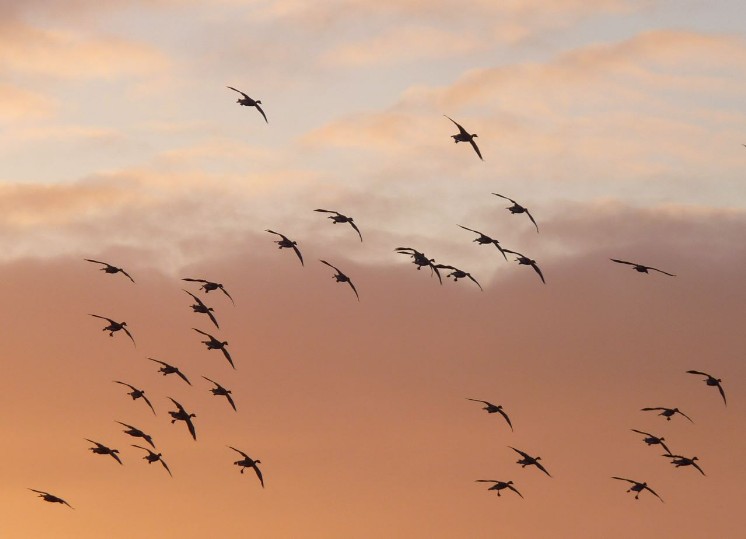
This August there was a change, with a number of people reporting Greylag Geese in the valley. People, who have lived in the area all of their life commented on how unusual this was. While the migratory birds are still in breeding grounds in Iceland, reports included one hundred and twenty Greylag Geese in Torbeg on 22nd, fifty in the Rodden on 27th and thirty-three flying from Blackwaterfoot over Brown Head on 29th.These are most likely naturalised Greylag Geese but not necessarily from Arran. One person, who spoke to me wondered if it could be the result of the excessively prolonged spell of dry weather in England causing the geese from drier areas to move and seek more suitable habit further north. That is a possible explanation.
Whatever the reason, there is something primeval about a flock of geese, the spectacle and the noise. There is a lot we do not know about the familiar Greylag Goose. If you do see them over the coming months, please take a moment to count the birds, check if any have readable collars and share your sighting with me.